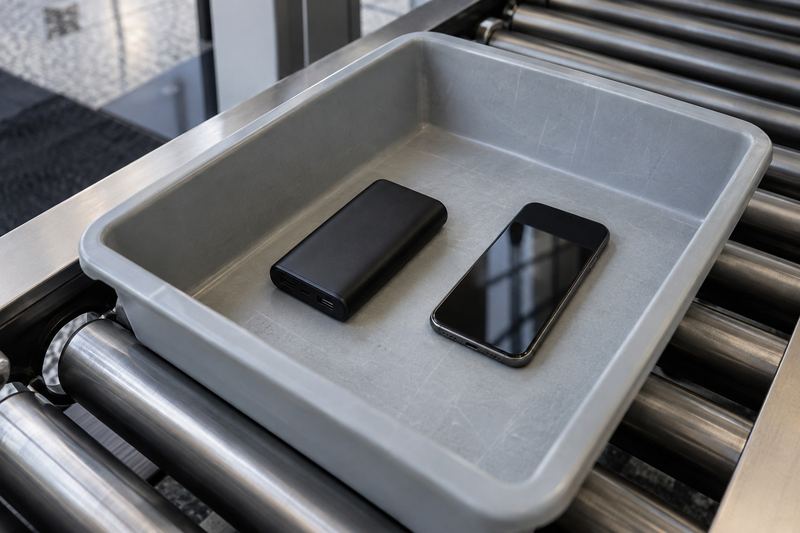
No power bank is officially "airline approved" or "TSA approved." Neither the TSA, the FAA nor any airline certifies portable chargers. A power bank can fly if it is rated 100 Wh or less, clearly shows its Wh rating (or mAh and volts), is undamaged and travels in your carry-on, never your checked bag.
Key facts
- Up to 100 Wh per power bank: allowed in carry-on with no airline approval (FAA).
- 101–160 Wh: airline approval needed, maximum two per person; over 160 Wh is forbidden.
- Power banks are banned from checked bags, including gate-checked carry-ons.
- International flights following ICAO (since 27 March 2026): no more than two power banks per person, and no recharging them on board.
- Wh = mAh × V ÷ 1,000. A 20,000 mAh bank at 3.7 V is about 74 Wh.
- Domestic flights in mainland China (since 28 June 2025): power banks without a clear 3C mark are banned.
Is there such a thing as an airline approved power bank?
Not as a product label. "Airline approved" and "TSA approved" are marketing phrases. The TSA screens items at the checkpoint; it does not test or certify chargers. The FAA sets limits on lithium batteries in baggage, but it does not keep a list of approved models. Airlines publish rules, not product lists.
The only "approval" that exists in the rules is the airline approval you need for a power bank rated 101–160 Wh. That is permission for a specific passenger on a specific flight, not a certification printed on a box. Many airlines no longer grant it for power banks at all: Delta, American and Southwest, for example, limit power banks to 100 Wh or less as of October 2026.
So when a listing promises an "airline approved" charger, read it as "designed to stay under 100 Wh." You still need to check the label yourself.
What makes a power bank allowed on a plane?
Every rule that matters can be checked by looking at the power bank itself. Before you fly, confirm these five things:
- Capacity of 100 Wh or less. This is the limit for carrying a power bank without asking anyone. See our watt-hour explainer if the unit is new to you.
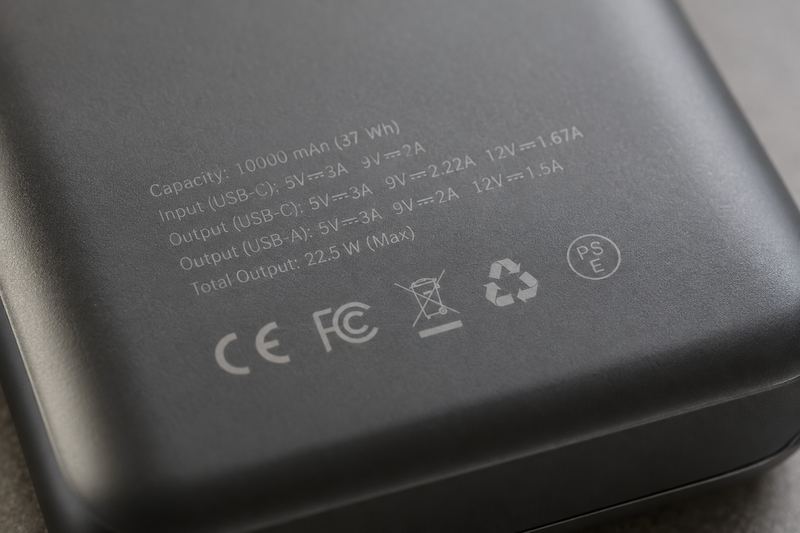
- A readable rating. The case should show watt-hours (Wh), or mAh plus a voltage so the Wh can be worked out. Security staff need to see it. China's aviation regulator, CAAC, explicitly requires the Wh rating to be clearly legible.
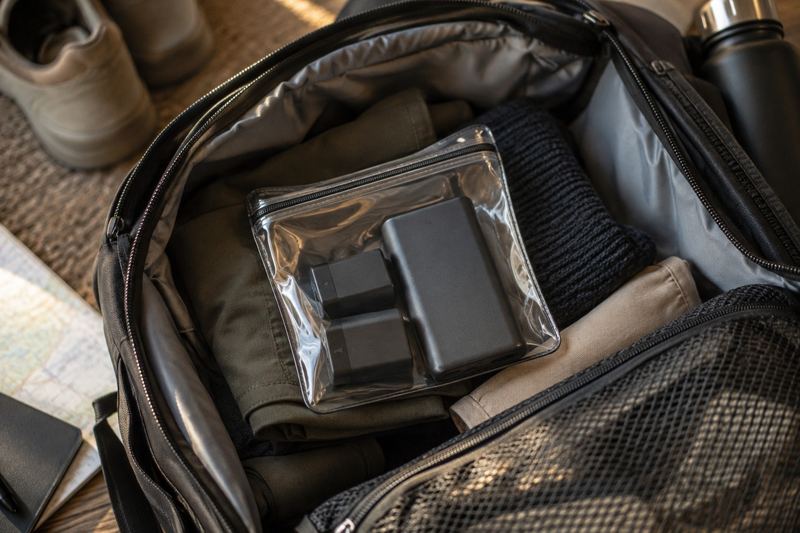
- Carry-on only. Power banks count as spare lithium batteries, so they must stay in the cabin. If your roller bag is taken at the gate, pull the power bank out first.
- Intact and not recalled. The FAA prohibits damaged, defective and recalled batteries. A bank that is swollen, cracked, scorched or that gets hot while idle should not travel.
- Protected terminals. Keep it in a pouch, its original packaging, or a separate pocket so nothing metal can touch the ports.
Full US rules are on our power bank item page.
How do I work out the Wh from mAh?
Multiply the mAh by the cell voltage and divide by 1,000. Power bank cells are usually rated 3.6–3.85 V, and 3.7 V is the most common figure printed on the case. Our mAh to Wh converter does the maths, and the power bank checker adds your airline's limits.
| Capacity | At 3.6 V | At 3.7 V | At 3.85 V | Verdict at 3.7 V |
|---|---|---|---|---|
| 5,000 mAh | 18 Wh | 18.5 Wh | 19.2 Wh | Carry-on, no approval |
| 10,000 mAh | 36 Wh | 37 Wh | 38.5 Wh | Carry-on, no approval |
| 15,000 mAh | 54 Wh | 55.5 Wh | 57.8 Wh | Carry-on, no approval |
| 20,000 mAh | 72 Wh | 74 Wh | 77 Wh | Carry-on, no approval |
| 25,000 mAh | 90 Wh | 92.5 Wh | 96.2 Wh | Carry-on, no approval |
| 26,800 mAh | 96.5 Wh | 99.2 Wh | 103.2 Wh | Carry-on, no approval |
| 27,000 mAh | 97.2 Wh | 99.9 Wh | 104 Wh | Carry-on, no approval |
| 30,000 mAh | 108 Wh | 111 Wh | 115.5 Wh | Needs airline approval |
| 40,000 mAh | 144 Wh | 148 Wh | 154 Wh | Needs airline approval |
| 50,000 mAh | 180 Wh | 185 Wh | 192.5 Wh | Not allowed |
If the case prints a Wh figure, use that number rather than your own calculation. The printed rating is what security staff will read.
Do certification marks matter?
Usually not at a US checkpoint, but they tell you something about how the bank was built, and in one country they are mandatory.
| Mark or test | What it covers | Required to fly? |
|---|---|---|
| UN 38.3 | UN transport tests for lithium cells and batteries | Yes. The UK CAA's summary of the ICAO rules says power banks must meet it. You can't check it at the airport, so buy from sellers that document it. |
| China 3C (CCC) | China's compulsory product certification | Yes, on domestic flights within mainland China since 28 June 2025. Banks with no 3C mark, an unclear one, or from recalled batches are banned. |
| UL 2056 | UL's safety standard titled "Power Banks," covering units of 100 Wh or less | No aviation rule requires it. It is a safety listing worth looking for. |
| IEC 62133-2 | International safety standard for portable sealed lithium cells and batteries | No aviation rule requires it. It is a sign the cells were safety-tested. |
A certification mark doesn't override capacity or condition. A certified bank over 100 Wh still needs airline approval, and a swollen one with a UL mark still shouldn't fly.
What should I look for in a travel power bank?
Since no product is officially approved, judge a power bank on features that make it easy to fly with. We don't rank or recommend brands.
- Capacity sweet spot: 10,000–27,000 mAh. A 10,000 mAh bank is about 37 Wh, light and enough for a phone top-up. A 20,000 mAh bank is about 74 Wh. Banks sold at 26,800 mAh or 27,000 mAh are built to land just under 100 Wh at 3.7 V.
- Check the printed Wh near the limit. At 3.85 V, 26,800 mAh works out to about 103 Wh. Near the top of the range, only buy a bank that prints a Wh figure of 100 or less.
- A permanent, legible label. Printed or engraved ratings survive better than stickers. A worn label can mean a long conversation at security.
- A solid case with no flex. Any bulge or gap between panels can be a sign of swelling. Check again before every trip.
- The right cable. Pack a short cable that matches your phone or laptop port. A built-in cable means one less thing to forget.
- Output that suits your devices. Laptops generally need higher-wattage USB-C output than phones. Check your device's charging specs.
- No recalls. Search the model on cpsc.gov before you fly.
How many power banks can I bring?
It depends on where you're flying and with whom.
- International flights (ICAO rule): since 27 March 2026, at most two power banks per passenger, and you may not recharge them on board. The UK CAA applies the same limit.
- US domestic flights: the FAA sets no general count for power banks of 100 Wh or less, but airlines can, and many do. Delta and American allow two. Southwest allows one per customer from 20 April 2026.
- Some international carriers are stricter still. Emirates and Etihad allow one power bank per passenger.
- Japan: since 24 April 2026, no more than two per passenger, none in overhead bins, and no charging other devices from them on board.
Check your airline before you pack. Our airline power bank rules hub compares the main carriers.
Can I use my power bank during the flight?
Often not. ICAO's rule bans recharging a power bank on board, and many airlines also ban using one to charge your phone in flight, or allow it only if the bank stays in view. Rules differ, and some airlines changed them in 2026, so read your carrier's page. Wherever you fly, keep the bank where you can reach it, not in the overhead bin, and tell a flight attendant at once if it gets hot, swells or smokes.
Questions people ask
What is a TSA approved portable charger?
There isn't one. TSA doesn't certify chargers. Any power bank of 100 Wh or less in your carry-on is allowed through the checkpoint, though the officer has the final say.
Is a 20,000 mAh power bank allowed on a plane?
Yes, usually. At 3.7 V it is about 74 Wh, under the 100 Wh limit, so it can go in your carry-on without airline approval.
What if my power bank only shows mAh?
Multiply the mAh by the voltage printed on it and divide by 1,000. If no voltage or Wh is shown at all, security may not be able to confirm its rating, so a clearly labeled bank is the safer choice.
Can I bring a 30,000 mAh power bank?
At 3.7 V a 30,000 mAh bank is about 111 Wh, which needs airline approval. Many airlines, including Delta, American and Southwest, don't accept power banks over 100 Wh.
Do I need a 3C mark to fly in China?
On domestic flights within mainland China, yes. Since 28 June 2025, CAAC has banned power banks without a clear 3C mark or from recalled batches.
Can I pack a power bank in my checked bag?
No. Power banks must stay in the cabin with you, even if your carry-on is checked at the gate. See our spare lithium batteries page for the same rule on loose cells.
Sources
- FAA: PackSafe, lithium batteries
- TSA: Power banks
- ICAO: New power bank restrictions will safeguard international aviation
- UK CAA: Changes to rules on the carriage of lithium cells/batteries and power banks
- CAAC: Ban on power banks without 3C marks or from recalls on domestic flights
- CAAC: Air travel guidance on power banks
- MLIT (Japan): Regarding bringing power banks on board
- UL Standards: UL 2056, Power Banks
- IEC: IEC 62133-2, safety requirements for portable lithium cells and batteries
- Southwest Airlines: Power banks/portable chargers
- American Airlines: Restricted items
- Delta Air Lines: Battery or fuel-powered items
- Emirates: Changes to safety rules for power banks onboard
- Etihad Airways: Prohibited items and dangerous goods