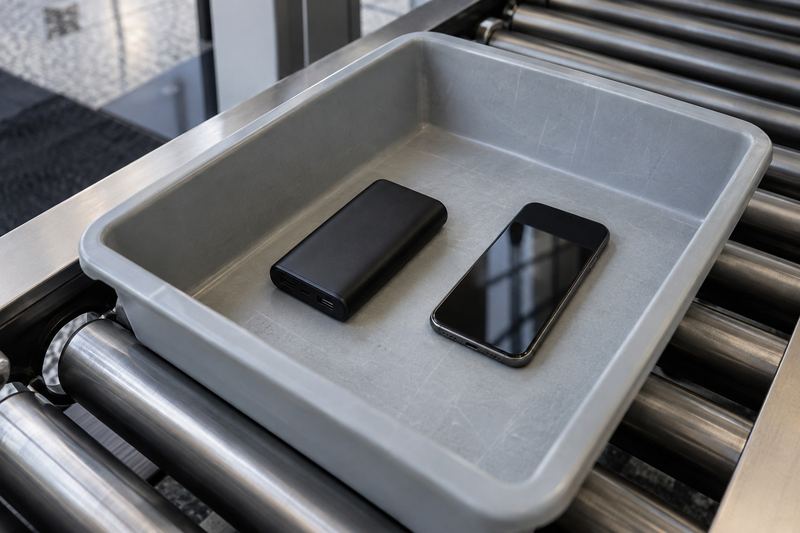
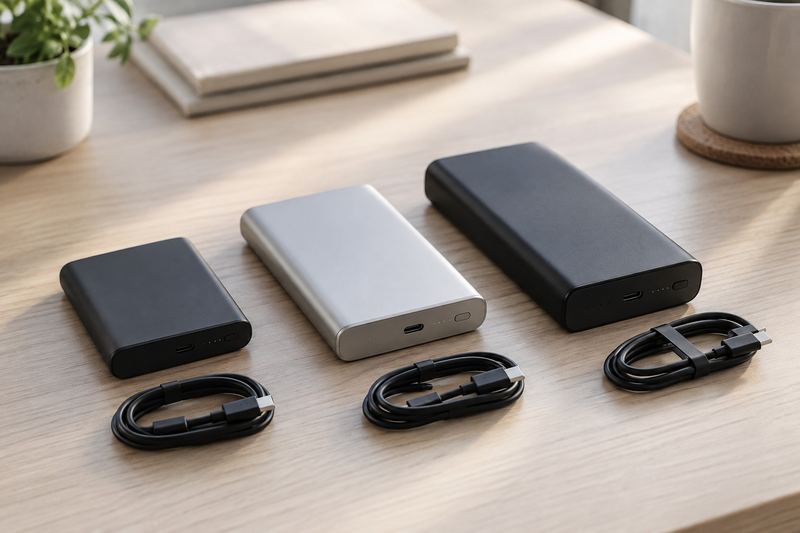
You can fly with lithium batteries, but where they go depends on the type. Batteries installed in devices can go in carry-on or checked bags, with devices switched fully off when checked. Spare lithium batteries and power banks are carry-on only. Lithium-ion is limited to 100 Wh per battery without approval, and lithium-metal to 2 g lithium.
Key facts
- Spare (uninstalled) lithium batteries and power banks: carry-on only, terminals protected.
- Lithium-ion: up to 100 Wh per battery without approval; 101–160 Wh with airline approval (max two spares); over 160 Wh forbidden.
- Lithium-metal: up to 2 g lithium per battery; 2–8 g with airline approval (max two spares).
- Ordinary alkaline, NiMH and NiCd batteries (AA, AAA, C, D, 9-volt) are allowed in carry-on and checked bags.
- Damaged or recalled batteries are banned from both carry-on and checked bags.
- If a battery or device overheats in flight, tell the crew immediately.
Installed vs spare batteries: what's the difference?
Most airline battery rules turn on one question: is the battery inside the device it powers, or loose?
- Installed: a battery fitted in a phone, laptop, camera, tablet or similar device. These can go in carry-on or checked bags within the Wh limits, though the FAA recommends keeping devices in the cabin.
- Spare: any battery not fitted in a device. That includes loose camera batteries, laptop batteries, 18650 cells, battery cases and power banks. Spares must travel in your carry-on, never in checked luggage.
If your carry-on is gate-checked or checked planeside, take out every spare lithium battery and power bank and keep them with you.
Lithium-ion battery limits by watt-hours
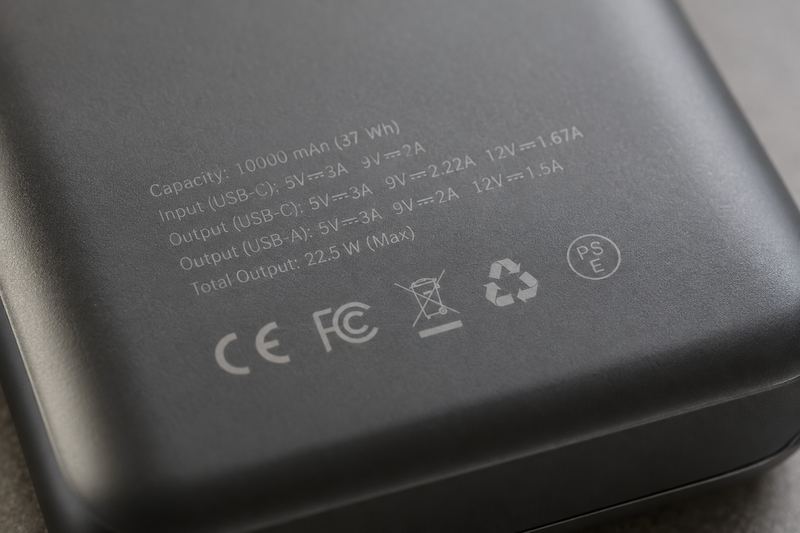
Rechargeable lithium-ion and lithium-polymer batteries are limited by their watt-hour (Wh) rating. Newer batteries print it on the case. If yours shows only mAh, multiply by the voltage and divide by 1,000, or use the mAh to Wh converter.
| Rating per battery | Installed in a device | Spare battery |
|---|---|---|
| 100 Wh or less | Carry-on or checked | Carry-on only, no approval |
| 101–160 Wh | Airline approval needed | Carry-on only, airline approval, max two |
| Over 160 Wh | Forbidden | Forbidden |
Almost all phones, tablets, laptops and camera batteries fall under 100 Wh. The 101–160 Wh tier mostly affects large professional video batteries and very large power banks. The FAA sets no count for personal-use batteries of 100 Wh or less, but it says airlines may set stricter quantity and Wh limits, and many now do for power banks. See our power bank guide for the two-per-person rule on international flights.
Lithium-metal batteries: the 2 g rule
Lithium-metal batteries are non-rechargeable. Examples include CR123A camera cells, lithium AA and AAA cells, and lithium coin cells. They are limited by lithium content, not Wh:
- Up to 2 g lithium per battery: allowed. Spares go in carry-on only.
- 2–8 g lithium: only with airline approval, and no more than two spares.
Lithium content is rarely printed on the battery. If you carry specialist or unusually large lithium-metal batteries, check the manufacturer's specification sheet before you fly.
Can you take AA batteries on a plane?
Yes. Ordinary dry-cell batteries (alkaline, nickel-metal hydride (NiMH) and nickel-cadmium (NiCd)) are allowed in both carry-on and checked bags. That covers AA, AAA, C, D, 9-volt and button sizes. Protect them from short circuit by keeping them in their packaging or a battery case so the terminals can't touch keys or coins. Tape the top of a 9-volt battery, because both of its terminals sit side by side.
One catch: AA and AAA cells labeled "lithium" are lithium-metal batteries. Loose spares of those must go in your carry-on. See the AA batteries page for more.
Can I put devices with lithium batteries in checked luggage?
Usually yes, for devices whose batteries are within the limits above, but:
- The device must be completely powered off. Sleep or standby mode doesn't count.
- Protect it from accidental activation and damage. Use a case, wrap it in clothing, and lock switches where you can.
- Take any spare batteries or power banks for it out of the checked bag.
The FAA still recommends carrying laptops and other devices in the cabin, where the crew can deal with a battery fire. Some devices have their own rules: e-cigarettes are banned from checked bags entirely (see below). For laptops specifically, see the laptop page.
E-cigarettes and vapes
Vapes and e-cigarettes, including disposables, are allowed only on your person or in your carry-on. The FAA bans them from checked bags. You can't charge them on the aircraft, and using them on board is banned on US flights under DOT smoking rules. Protect them from accidental activation, and carry spare vape batteries under the spare-battery limits above. E-liquid in your carry-on follows the 3.4 oz (100 ml) liquids rule. Details are on the vapes page.
Smart luggage and AirTags
Smart luggage with a built-in lithium battery can be carried on. To check it, you must remove the battery and carry the battery in the cabin, unless it holds no more than 0.3 g lithium (lithium-metal) or 2.7 Wh (lithium-ion). A smart bag with a non-removable battery has to stay in the cabin.
AirTags and similar trackers are allowed in checked bags because their batteries fall under the same small-battery limits of 0.3 g lithium or 2.7 Wh. Rechargeable GPS trackers with bigger batteries may not qualify, so check the specs.
Damaged, swollen or recalled batteries
The FAA bars damaged or recalled batteries, and devices containing them, from aircraft in any bag. The only exception is when the battery has been removed or otherwise made safe. Leave a battery at home if it is:
- swollen, bulging or lifting the case of the device,
- cracked, punctured, leaking, or showing scorch marks,
- part of a recall. Check the manufacturer's notice or cpsc.gov before you travel.
What should I do if a device overheats during the flight?
Tell a flight attendant immediately. The FAA asks passengers to notify the crew right away if a battery or device is overheating, expanding, smoking or giving off an unusual smell, and cabin crews are trained to handle lithium battery fires. That is also why airlines increasingly ask you to keep batteries and power banks where you can see and reach them, not in the overhead bin: in 2025 the FAA warned airlines (SAFO 25002) that a battery overheating inside a stowed bag is hard to spot.
How to pack spare lithium batteries
- Keep each spare in its original packaging, a battery case, a terminal cap or its own small plastic bag, or tape over the terminals.
- Keep spares away from keys, coins and other metal.
- Pack them in the bag you keep with you, ideally under the seat rather than in the overhead bin.
- Carry personal-use quantities only. Batteries for sale or distribution aren't allowed.
For the full item-by-item rules, see spare lithium batteries.
Questions people ask
Can lithium-ion batteries go in checked luggage?
Only when installed in a device that is fully switched off and protected. Spare lithium-ion batteries and power banks are banned from checked bags and must go in your carry-on.
Can you take batteries on a plane?
Yes. Alkaline and NiMH batteries can go in any bag. Lithium batteries are allowed within the Wh or lithium-content limits, with spares in carry-on only.
How many lithium batteries can I bring on a plane?
The FAA sets no number for personal-use batteries of 100 Wh or less, but airlines may. Larger 101–160 Wh spares are limited to two with airline approval, and international flights allow at most two power banks.
Are lithium AA batteries allowed on planes?
Yes. They are lithium-metal batteries, so loose spares must go in your carry-on. Batteries installed in a device can be checked.
Can I bring a spare laptop battery on a plane?
Yes, in your carry-on only, with the terminals protected. Most are under 100 Wh; one rated 101–160 Wh needs airline approval.
Sources
- FAA: PackSafe – Lithium batteries
- FAA: Airline passengers and batteries
- FAA: PackSafe – Portable electronic devices containing batteries
- FAA: Lithium batteries in baggage
- FAA: PackSafe – Electronic cigarettes, vaping devices
- FAA: PackSafe – Baggage equipped with lithium batteries
- FAA: SAFO 25002 – Lithium batteries carried by passengers
- TSA: Lithium batteries with 100 watt hours or less
- TSA: Lithium batteries with more than 100 watt hours
- TSA: Dry batteries (AA, AAA, C and D)
- TSA: Electronic cigarettes and vaping devices
- eCFR: 14 CFR Part 252 – Smoking aboard aircraft
- UK CAA: Changes to rules on the carriage of lithium cells/batteries and power banks