The 100 ml liquid rule still applies in most countries: each container in your hand luggage can hold up to 100 ml, packed in one clear bag of about 1 liter. Some UK and EU airports with newer scanners, including Heathrow, Gatwick and Dublin, now allow containers of up to 2 liters. The US limit is 3.4 oz (100 ml).
Key facts
- The default almost everywhere is 100 ml per container in one clear bag of up to 1 liter per person.
- As of October 2026, Heathrow, Gatwick and Dublin allow containers of up to 2 liters. Manchester keeps 100 ml but has dropped the bag.
- The rule depends on the airport, not the country. Check your departure airport, any connection and your return airport.
- Australia and New Zealand limit liquids only on international flights.
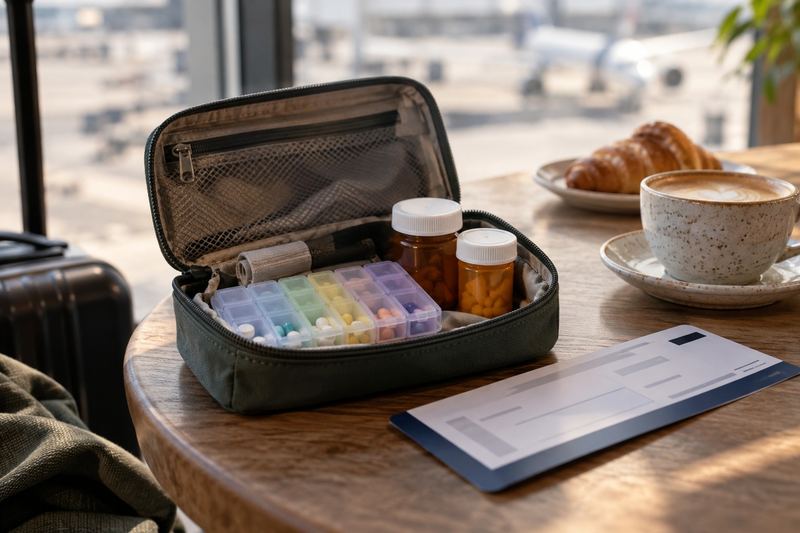
- Medicines, special dietary liquids and baby food or milk are exempt almost everywhere, but are still screened.
Liquid rules by country at a glance
| Country or region | Container limit | Bag | Notes |
|---|---|---|---|
| United States | 3.4 oz (100 ml) | One quart-size bag | No official change as of October 2026 |
| United Kingdom | 100 ml standard; up to 2 L at some airports | 1 L bag where required | Varies by airport |
| European Union | 100 ml standard; larger at some airports | 1 L bag where required | Varies by airport and terminal |
| Canada | 100 ml | One 1 L bag | Inorganic powders under 350 ml |
| Australia | 100 ml, international flights only | About 20 x 20 cm | No liquid limit on domestic flights |
| New Zealand | 100 ml, international flights only | 1 L total, about 20 x 20 cm | No liquid limit on domestic flights |
| Singapore | 100 ml | One 1 L bag, fully closed | No 2 L relaxation on Changi's pages |
| Japan | 100 ml, international flights only | One 1 L zip-top bag | Separate 0.5 L / 2 L toiletry caps on all flights |
What is the UK hand luggage liquids rule in 2026?
The UK no longer has one rule. The government's standard rule is 100 ml per container, even if the container is only part full, in one clear, resealable bag of no more than 1 liter, about 20 cm x 20 cm. The bag must close fully; tying the top is not allowed. GOV.UK says some airports allow containers of up to 2 liters, and that not every airport still asks for the bag.
GOV.UK does not name the airports, so we only list rules we confirmed on each airport's own website. As of October 2026:
- Heathrow: containers of up to 2 liters each, kept in your cabin bag. Laptops and tablets can stay in your bag. Empty metal and insulated bottles before security.
- Gatwick: containers of up to 2 liters that stay in your hand luggage, as long as they are not metal or double-walled. Open drinks must be in a container that can be resealed.
- Manchester: still 100 ml per container, but no plastic bag is needed and liquids can stay in your bag. Travel bottles must have their capacity printed on them; handwritten labels are not accepted.
We have not confirmed other UK airports on official pages. If you fly from anywhere else, check that airport's security page before you pack, and assume 100 ml if it is unclear.
At every UK airport, essential medicines, special dietary liquids and baby food or milk can be carried in containers of up to 2 liters. Liquid medicine over 100 ml needs proof it is prescribed to you, such as a doctor's letter or a copy of the prescription. More on the UK rules.
What are the EU liquid rules at airports?
The European Commission's baseline is the same as the UK's: 100 ml per container, in one transparent resealable bag of no more than 1 liter. Medicines and special dietary products, including baby food, are exempt.
Airports with approved next-generation scanners may allow larger containers. The history is messy: in 2024 the Commission sent airports using certain scanners back to the 100 ml limit from 1 September 2024 to fix a technical issue, and some airports have relaxed the rule again since. Rules can differ between airports and even between terminals at the same airport.
- Dublin: containers of up to 2 liters can go through security, and liquids no longer need to be in a clear bag. Dublin announced the change for both terminals from 17 September 2025.
We have not confirmed other EU airports on official pages. Check your departure airport's security page. Duty-free liquids bought at EU airports or on EU airlines are allowed if they stay sealed in the tamper-evident bag with proof of purchase. See the EU rules.
Canada
CATSA keeps the classic rule: liquids, aerosols, gels and non-solid foods in containers of 100 ml (3.4 oz) or less, all in one clear resealable bag of no more than 1 liter, one bag per passenger. Spreads such as peanut butter, jam and yogurt count. Canada also limits inorganic powders such as baby powder, bath salts or sand to less than 350 ml or 350 g. Prescription and essential non-prescription medicines, and baby food, milk, formula, water and juice for children under 2, are exempt; declare them to the officer. CATSA's pages mention no relaxation tied to new scanners. See the Canada rules.
Australia and New Zealand
Both countries apply the 100 ml rule only on international flights. Domestic flights have no liquid quantity limit.
- Australia: containers of 100 ml or 100 g or less in a resealable clear bag of about 20 cm x 20 cm. Inorganic powders such as salt, talc or sand are limited to 350 ml or 350 g. Duty-free liquids are not automatically exempt and may be rescreened or taken at transit points. On domestic flights, aerosols still need a cap. See Australia.
- New Zealand: containers of 100 ml or less, no more than 1 liter in total, in one resealable bag of about 20 cm x 20 cm. Inorganic powders are limited to 350 ml or 350 g. Prescribed medicine can exceed the limits if it is in your name and in its original packaging. See New Zealand.
Singapore
Changi applies 100 ml per container, no more than 1 liter in total, in one transparent resealable bag per passenger that must be fully closed. Containers over 100 ml are refused even if partly empty, and non-compliant liquids must be thrown away before screening. Baby food and breast milk are exempt when the infant travels with you; liquid medicines over 100 ml need a genuine doctor's letter. Changi's pages mention no 2-liter relaxation.
Japan
On international flights from Japan, all liquids, gels and aerosols must be in containers of 100 ml or less inside one transparent zip-top bag of up to 1 liter per passenger. Medicines, baby milk or food and special diets are exempt in the amount you need for the flight; for medicine, show a prescription copy, pharmacy bag or doctor's certificate.
Japan also applies dangerous-goods limits to toiletries, medicines and sprays on all flights, including domestic: 0.5 liters or 0.5 kg per container and 2 liters or 2 kg in total per person.
United States
TSA's rule is 3.4 oz (100 ml) per container, all in one quart-size bag, one bag per passenger. As of October 2026, TSA has announced no change to the limit. Duty-free liquids bought abroad can go through TSA screening on a US connection only if sealed in a tamper-evident bag with a receipt from the last 48 hours. Full details are in our TSA liquids rule guide.
Which rule applies on a connecting flight?
Every time you go through security, the rules of that checkpoint apply. A 2-liter bottle that passed security at Heathrow or Dublin can be confiscated if you have to clear security again at a connecting airport that still uses 100 ml, including when you connect in the US. In practice, the strictest airport on your route sets your limit.
- Check the rule at your departure airport, every connection where you clear security, and your return airport.
- If any airport on the route uses 100 ml, pack to 100 ml and use a 1-liter bag.
- Keep duty-free purchases sealed in their bag with the receipt until your final destination.
- When in doubt, put larger bottles in your checked bag.
A small clear bag that meets the 1-liter rule works almost everywhere. Our toiletry bag guide explains what to look for.
Questions people ask
Which airports allow 2 litres of liquid?
As of October 2026, Heathrow, Gatwick and Dublin confirm on their own websites that containers of up to 2 liters are allowed. Other airports may too, but check your airport's official security page before you rely on it.
Has the 100ml rule been scrapped in the UK?
Not everywhere. GOV.UK still sets 100 ml as the standard, and only some airports allow larger containers. Manchester, for example, still applies 100 ml per container.
Can I take 2 litres on my return flight?
Only if the airport you fly home from allows it. Your return flight follows the rules at that airport, not the one you left from.
Do I still need a plastic bag for liquids in Europe?
At most airports, yes: one clear resealable bag of up to 1 liter. Dublin and Manchester say a bag is no longer needed, and Heathrow and Gatwick let liquids stay in your hand luggage, so check your airport.
Is medicine exempt from the 100ml rule abroad?
Generally yes, in the UK, EU, Canada, Australia, New Zealand, Singapore and Japan, but rules on proof differ. Carry a prescription copy or doctor's letter for liquids over 100 ml; see flying with medication.
Sources
- GOV.UK: Hand luggage restrictions at UK airports, liquids
- GOV.UK: Hand luggage restrictions, medicines and medical equipment
- Heathrow: Security and baggage
- Gatwick Airport: Security
- Manchester Airport: Security
- European Commission: Information for air travellers
- Dublin Airport: Security
- CATSA: Liquids, non-solid food and personal items
- Brisbane Airport: Powders, liquids, aerosols and gels
- Aviation Security Service (NZ): Powders, liquids, aerosols and gels
- Changi Airport: Security and baggage restrictions
- MLIT (Japan): Restrictions on liquids in the cabin on international flights
- TSA: Liquids rule