A TSA-friendly carry-on holds your ID, medication, valuables, every power bank and spare lithium battery, solid snacks, and liquids of 3.4 oz (100 ml) or less in one quart-size bag. Knives, tools over 7 inches and full-size toiletries go in checked luggage. Pack by bag area so screening and gate checks are quick.
Key facts
- Liquids, gels and aerosols: 3.4 oz (100 ml) per container, one quart-size bag per passenger.
- Medication, baby formula and breast milk can exceed 3.4 oz in reasonable amounts; tell the officer at screening.
- Power banks, spare lithium batteries and vapes must be in your carry-on, never checked.
- Since May 7, 2025, a state driver's license or ID used to fly within the US must be REAL ID compliant.
- Solid food has no TSA quantity limit; dips and spreads count as liquids.
What should you pack in your carry-on first?
Start with anything you can't replace or can't check. Work through the bag one zone at a time: documents, liquids bag, electronics, medication, food, and personal-care items. Each section below ends with what to move to your checked bag instead.
Documents and valuables
- Photo ID for every adult. TSA accepts a REAL ID-compliant license or state ID, a US passport or passport card, a trusted traveler card and several other documents. A temporary paper license is not accepted. TSA doesn't require ID from children under 18 on US flights, but ask your airline.
- Passport and any visas for international trips.
- Boarding pass, on your phone or printed.
- Wallet, cards, keys and jewelry.
- Copies of prescriptions and travel insurance details.
Check: look at your keychain. A tiny keyring knife is still a knife, and knives of any size are banned from carry-on bags.
Liquids bag
Everything liquid, gel, cream, paste or aerosol goes in containers of 3.4 oz (100 ml) or less, in one quart-size bag. See the TSA liquids rule guide for the details.
- Toothpaste, mouthwash and lip gloss.
- Deodorant (gel, roll-on or spray; solid sticks have no limit and don't need the bag).
- Shampoo, conditioner, face cream, lotion and sunscreen in travel sizes.
- Perfume and hairspray in small bottles.
- Contact lens solution and hand sanitizer.
- Mini liquor bottles, if you want them at your destination. You can't drink your own alcohol on board.
Move to checked: full-size bottles and aerosol cans. In checked bags, aerosols and other restricted toiletries such as perfume and hairspray can hold up to 18 oz (500 ml) per container, with a total of 70 oz (2 L) per person, and aerosol nozzles must be capped. Flammable aerosols that aren't toiletries, such as spray paint or cooking spray, can't fly at all.
Electronics pouch
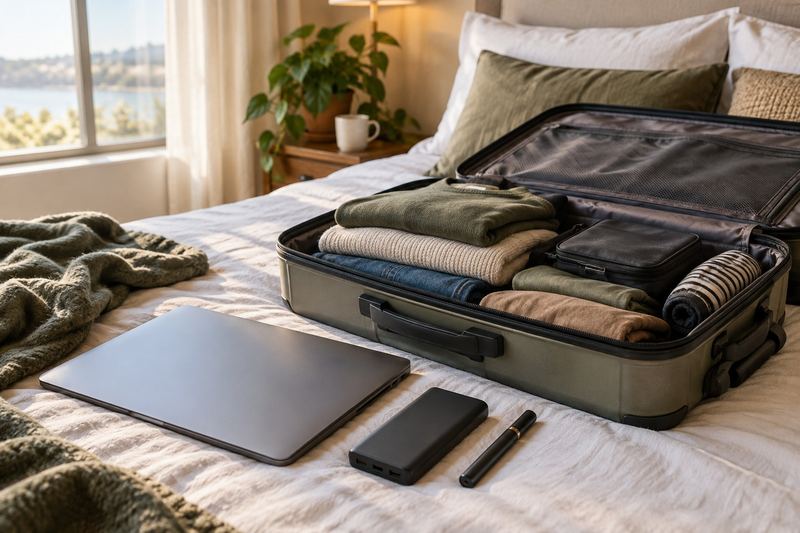
Keep everything with a battery together in one pouch near the top of the bag. It makes screening easier, and if the airline gate-checks your bag you can lift the pouch out in seconds.
- Phone, earbuds, plug-in chargers and cables.
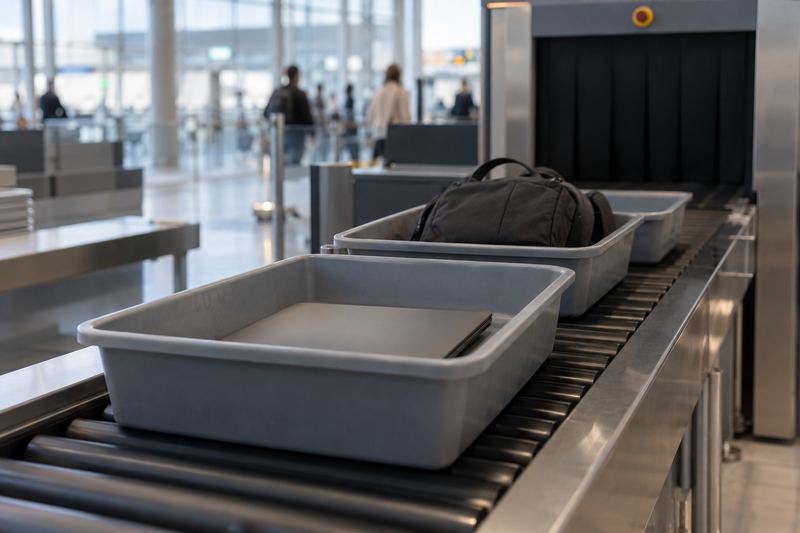
- Laptop and tablet. In standard lanes, take the laptop out and put it in its own bin; TSA PreCheck travelers can leave it in. Charge it in case an officer asks you to switch it on.
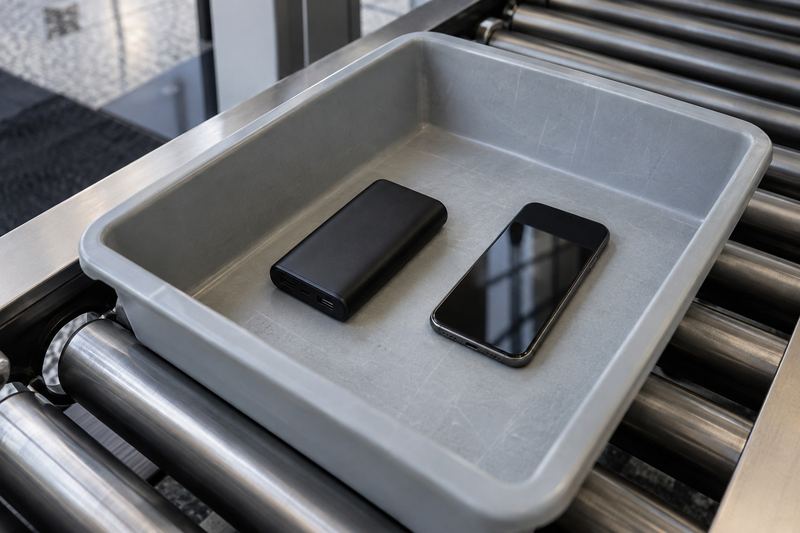
- Power banks: up to 100 Wh with no approval. A 20,000 mAh bank at 3.7 V is 74 Wh. Use the power bank checker if you're unsure.
- Spare camera, drone and laptop batteries, with terminals taped or in a case.
- Vapes and e-cigarettes. No charging or using them on the plane.
- Cordless hair tools, with a safety cover over the heating element.
Do not move to checked: this is the zone that works the other way round. Power banks, spare lithium batteries, vapes and cordless hair tools are banned from checked bags. If your bag is gate-checked, take them out. Our carry-on-only items guide covers the full list.
Medication
- Pills and other solid medication. TSA sets no quantity limit and doesn't require original bottles, though your state's labeling laws apply.
- Liquid medication over 3.4 oz (100 ml) in reasonable amounts. It doesn't need to go in the quart bag; declare it at screening.
- Insulin and diabetes supplies. Unused syringes must travel with the injectable medication, and used ones go in a sharps container.
- Inhalers and EpiPens. Declare them; they don't go in the liquids bag.
- Ice packs or gel packs to keep medication cool.
- A CPAP machine. On US airlines, an assistive device like a CPAP doesn't count toward your carry-on allowance.
Keep all medication in your carry-on so a delayed checked bag can't separate you from it. For questions about doses or timing across time zones, check with your doctor or pharmacist. More in our flying with medication guide.
Food and drink
- Solid snacks: crackers, nuts, granola bars, sandwiches, candy and fruit.
- An empty water bottle or tumbler to fill after security.
- Baby formula, breast milk and baby food in amounts over 3.4 oz. Tell the officer and expect them to be screened separately.
Move to checked: dips, spreads, soups, jams, peanut butter and sauces in containers over 3.4 oz (100 ml). Coming home from abroad, declare all food to US Customs, and note that many fresh fruits and vegetables can't go from Hawaii or Puerto Rico to the mainland.
Sharp-ish and personal-care items
These are allowed in a carry-on on US flights:
- Nail clippers, metal nail files and tweezers.
- Disposable and cartridge razors. A safety razor only with the blade removed.
- Scissors with blades under 4 in (10 cm) from the pivot.
- Knitting needles, crochet hooks, sewing needles and safety pins.
- Tools 7 in (17.8 cm) or shorter, measured assembled.
- One disposable or Zippo-type lighter or one book of safety matches.
- A corkscrew without a blade, and an umbrella.
Move to checked: knives of any size, multi-tools with a blade, loose razor blades, corkscrews with a foil blade, longer scissors and tools, and sports gear such as bats and golf clubs. Wrap anything sharp. The prohibited items guide lists what's banned from both bags.
Last check before you leave
- Liquids bag closed and easy to reach.
- Electronics pouch packed, devices charged.
- Medication and ID in your carry-on, not your checked bag.
- No knives, blades or long tools left in pockets or side compartments.
- Checked bag free of power banks, spare batteries and vapes.
TSA officers have the final say at the checkpoint, so if an item is borderline, pack it in checked luggage. Flying abroad? Liquids and sharp-item rules differ by country; see our international rules.
Questions people ask
What can I pack in my carry-on for TSA?
Liquids of 3.4 oz (100 ml) or less in one quart-size bag, electronics, power banks, medication, solid food, and small personal items like nail clippers and tweezers. Knives and tools over 7 inches must be checked.
Does deodorant go in the liquids bag?
Gel and spray deodorants do, at 3.4 oz (100 ml) or less. Solid stick deodorant doesn't count as a liquid.
Can I bring my medication in my carry-on?
Yes. Pills have no TSA quantity limit, and liquid medication over 3.4 oz is allowed in reasonable amounts if you declare it at screening.
Do I have to take my laptop out at security?
In standard lanes, yes: it goes in its own bin. TSA PreCheck travelers can usually leave it in the bag.
Can I bring food in my carry-on?
Yes. Solid food has no TSA limit. Spreadable or liquid foods must be 3.4 oz (100 ml) or less and go in your liquids bag.
Sources
- TSA: What is the 3-1-1 liquids rule?
- TSA: Identification
- TSA: Laptops
- TSA: Power banks
- TSA: Electronic cigarettes and vaping devices
- TSA: Can you pack your meds in a pill case?
- TSA: Insulin
- TSA: What Can I Bring? Medical
- TSA: Breast milk
- TSA: Snacks
- TSA: Coffee thermos (empty)
- TSA: Fresh fruits and vegetables
- TSA: Scissors
- TSA: Screwdrivers (shorter than 7 inches)
- TSA: Razor-type blades
- TSA: What Can I Bring? Sharp objects
- TSA: Knives
- TSA: Lighters (disposable and Zippo)
- FAA PackSafe: Medicinal and toiletry articles
- FAA PackSafe: Aerosols
- FAA PackSafe: Lithium batteries
- eCFR: 14 CFR 382.121 (assistive devices in the cabin)
- eCFR: 14 CFR 121.575 (alcoholic beverages)
- USDA APHIS: Traveling from Hawaii with agricultural products
- USDA APHIS: Traveling from Puerto Rico and the US Virgin Islands
- TSA: What Can I Bring? (Deodorant listing)